“I give you truth in the pleasant disguise of illusion”
The Glass Menagerie“I give you truth in the pleasant disguise of illusion” is Tom’s concise statement of how The Glass Menagerie turns memory into theatre: it openly alters the appearance of events so that their emotional reality can be felt. The line links Tom’s role as both narrator and character to the play’s dim, musical, nonrealistic form, where selective images and recurring motifs carry truths that literal realism might miss.
The Narrator’s Artistic Contract
Tom speaks the line directly to the audience after entering in a merchant sailor’s clothes and stopping on the fire escape to light a cigarette. He contrasts his practice with that of a stage magician: rather than giving the audience an illusion that merely looks true, he offers truth in an illusory form. The declaration makes the play’s artifice explicit. The audience is invited to recognize that the past is being staged and shaped, not presented as an unmediated record.
That shaping belongs to Tom’s double position. He is the play’s undisguised narrator, free to take whatever license with dramatic convention serves his purposes, and also a character in the events he recounts. His opening commentary turns back time to the 1930s and places the family story against a background of economic dissolution and labor unrest. The play thus moves between the remembered household and the older Tom’s act of telling it, with the past made present through a self-conscious theatrical frame.
Memory, Selection, and Form
The production notes explain why this account does not aim at photographic fidelity. Because the play is a memory play, it may omit details and exaggerate others according to their emotional value; memory, the notes say, is seated predominantly in the heart. The interior is consequently dim and poetic. Nonrealism is not described as an escape from reality, but as a means of approaching it more closely through transformation and suggestion.
This principle also informs Williams’s wider conception of a plastic theatre. He proposed a reduced, sculptural stage movement, organized around significant attitudes and tableaux rather than ordinary realistic activity. In his account, combining elements associated with expressionism with romantic lyricism could create a new theatrical force. Tom’s line gives this formal project a dramatic voice: the visible fiction is acknowledged as fiction, while its transformations are meant to disclose rather than conceal experience.
Theatrical Devices and Emotional Emphasis
The proposed screen device would have projected images or titles onto a section of wall between the front room and dining room. Williams described it as a way to accent the structurally important point of an episode, clarify what the writing leaves allusive, and prevent the play’s episodic shape from seeming merely fragmentary. The device was omitted from the acting version and the original Broadway production; Williams accepted that choice in light of Laurette Taylor’s performance and the suitability of a simple physical production. Its intended function nevertheless clarifies the line’s aesthetic: theatrical signs could make an underlying meaning legible without relying entirely on explanatory dialogue.
Music performs a related work. The recurring tune called “The Glass Menagerie” moves in and out of the play, connecting the narrator’s separate time and place with the subject of his story. Its surface lightness carries an underlying sorrow, and Williams identifies it primarily as Laura’s music, most distinct when the action focuses on her and the fragile beauty of glass. The tune therefore does more than accompany the remembered scenes: it acts as an emotional thread through the episodes, giving sound to the nostalgia that shapes the act of recollection.
The Ending as the Line’s Test
At the close, Tom’s account shows the cost of leaving without turning his escape into release from the past. He says that he left St. Louis after being fired for writing a poem on a shoe-box lid, and that he followed his father’s footsteps, trying to find through movement what had been lost in space. He describes travelling among cities, yet being overtaken unexpectedly by a familiar piece of music or an image of transparent glass. The imagined shop window, filled with tiny colored bottles like fragments of a shattered rainbow, brings Laura back into his consciousness.
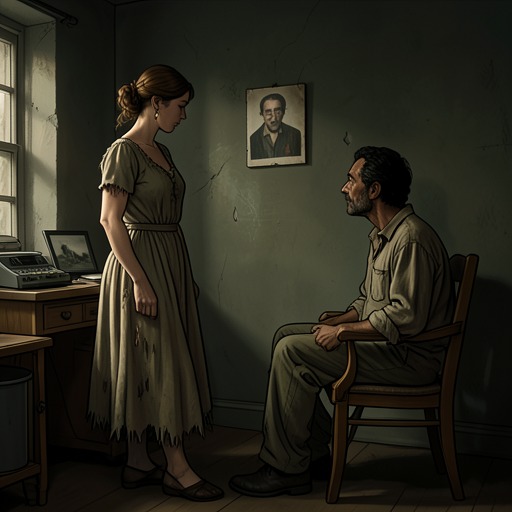
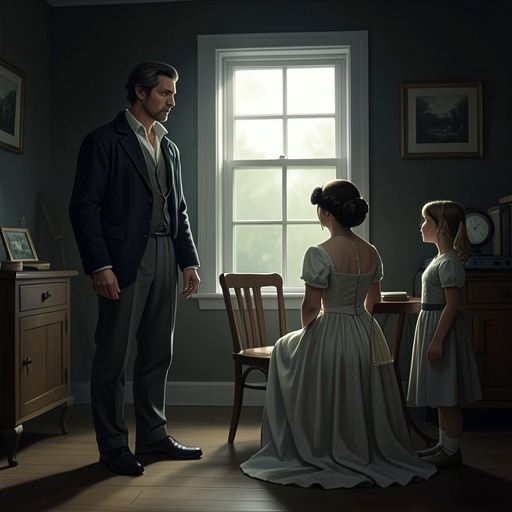
As Tom speaks, Amanda silently comforts Laura on the sofa. Seen as though through soundproof glass, Amanda’s gestures become slow and graceful; Laura eventually lifts her head to smile at her mother, then bends to extinguish the candles. Tom admits that he tried to leave Laura behind but remains more faithful to her than he intended, and describes fleeing into a cinema or bar, buying a drink, or speaking to a stranger in an effort to escape her remembered presence. The final candlelight going out joins theatrical image to emotional truth: Tom can depart in life, but the act of narration reveals that memory has kept his sister with him. The line is therefore not merely a defense of illusion; it names the means by which a departed narrator makes loss visible, while showing that the truth he stages continues to wound him.